
Best Time to Take Inositol: Morning or Night?
Wondering whether to take inositol in the morning or at night? This guide explains how timing usually fits into the routine and what matters more than the clock.
by Eco Hormone Balance Editorial Team · Published August 25, 2025 · Evidence & product details rechecked August 7, 2026
How we evaluate these products
This comparison is a desk-research review. We base it on product labels, manufacturer and retailer information, and peer-reviewed evidence (PubMed/PMC), assessed under a multidisciplinary editorial framework covering clinical, pharmacy, dietetics, and supplement-quality criteria.
- Formula and ratio against the studied evidence
- Daily dose and serving burden
- Third-party testing and certifications
- Price per day (with the check date shown)
- Availability in the US market
- Safety, interactions, and who should ask a clinician first
We have not independently lab-tested these products. Rankings reflect formula, evidence alignment, and practical criteria — never commission.
Product details and prices checked August 7, 2026 — prices vary by retailer and over time.
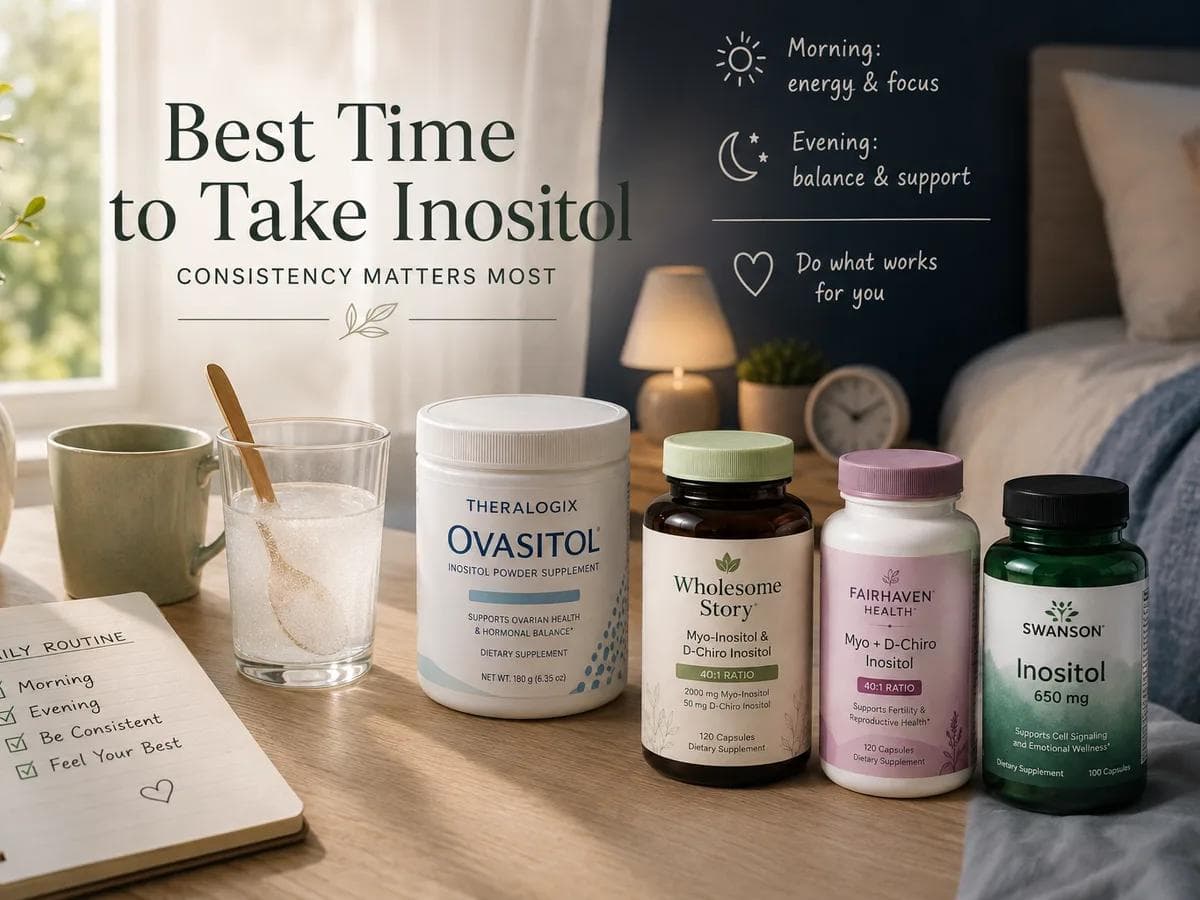
Morning or night? The question feels simple, but it is usually about something else: whether the routine will survive contact with a real week. Buyers asking about timing are trying to find the version of this habit that is easiest to repeat — and that is the right instinct.
This page keeps the answer practical. There is no evidence that one hour of the day is meaningfully better than another; the studied pattern is a split dose, and the schedule that wins is the one you can actually keep.
Quick answer
Consistency beats clock precision. The strongest timing choice is the one that reduces friction and keeps the routine easy to repeat.
For twice-daily products, morning and evening is the cleanest default — it matches how most clinical trials split the dose.
If a serving upsets your stomach, anchor it to a meal. Use timing as a tolerance tool, not a ritual.
What the evidence does — and doesn't — say about timing
Clinical trials typically dose inositol as 2 g of myo-inositol twice daily (4 g per day, with D-chiro at the 40:1 ratio), sustained for roughly three to six months. That split pattern — not a specific hour of the day — is what the evidence is built on.
No major trial compared morning-only against night-only dosing. What the studies show is that consistent, split dosing works. The 40:1 ratio itself, and the daily total, matter more than whether the first serving lands at 7 a.m. or 9 a.m.
When timing can actually matter
Timing starts to matter when the routine has friction points: a higher serving burden, digestive sensitivity, or a formula that feels heavy. Inositol's most documented side effects are mild gastrointestinal ones that are often dose-related — if a serving bothers you, pairing it with food is a reasonable adjustment.
Powders often fit a morning and evening rhythm because mixing a drink twice a day is easy to attach to existing habits. Capsules can be easier for people who travel, work irregular hours, or want to carry the dose with them.
Morning or night by product type
Powder-first products like Ovasitol are designed around a twice-daily routine, so anchoring them to morning and evening meals is the natural fit. Capsule-first options are more flexible — the same split works whether you are at home or out of the house.
Plain inositol products are the most flexible of all, because there are no added ingredients to consider. Move them wherever the day allows; the priority is simply hitting the daily total consistently.
The takeaway: choose the schedule you can repeat
Split the dose morning and evening if the product is twice-daily, use food when a serving feels heavy, and stop treating the clock like the deciding factor.
Final verdict
Morning versus night is not the real decision. The real decision is whether the format and serving burden fit your life well enough to stay consistent. If that part works, the timing — morning, evening, or split — is the easy part.
What to read next
Finish your research with the guides that explain the formula, then compare the leading products before you commit.
References
- The 40:1 myo-inositol/D-chiro-inositol plasma ratio is able to restore ovulation in PCOS patients: comparison with other ratios
- Inositol for Polycystic Ovary Syndrome: A Systematic Review and Meta-analysis to Inform the 2023 Update of the International Evidence-based PCOS Guidelines
- Inositol is an effective and safe treatment in polycystic ovary syndrome: a systematic review and meta-analysis of randomized controlled trials
- Myo-inositol effects in women with PCOS: a meta-analysis of randomized controlled trials
Frequently Asked Questions
There is no evidence that one time of day is better. Clinical trials split the dose (commonly 2 g twice daily) rather than favoring a specific hour, so the best time is the one you can repeat consistently.
Sleep disruption is not a documented side effect of inositol. The main tolerability issue is mild gastrointestinal discomfort, which is why pairing a serving with food can help.
Food is a tolerance tool, not a requirement. Trials dose with meals and between meals without showing that one is clearly better; if a serving upsets your stomach, taking it with a meal is a reasonable adjustment.
The studied pattern is a split dose (commonly 2 g twice daily). Taking the full daily total in one sitting is less studied, so splitting remains the safer default unless a clinician suggests otherwise.