
Best Inositol for Ovulation With PCOS: What Actually Makes Sense?
Looking for the best inositol for ovulation with PCOS? This guide explains which product types make the most sense and how to think about the category clearly.
by Eco Hormone Balance Editorial Team · Published March 12, 2026 · Evidence & product details rechecked August 7, 2026
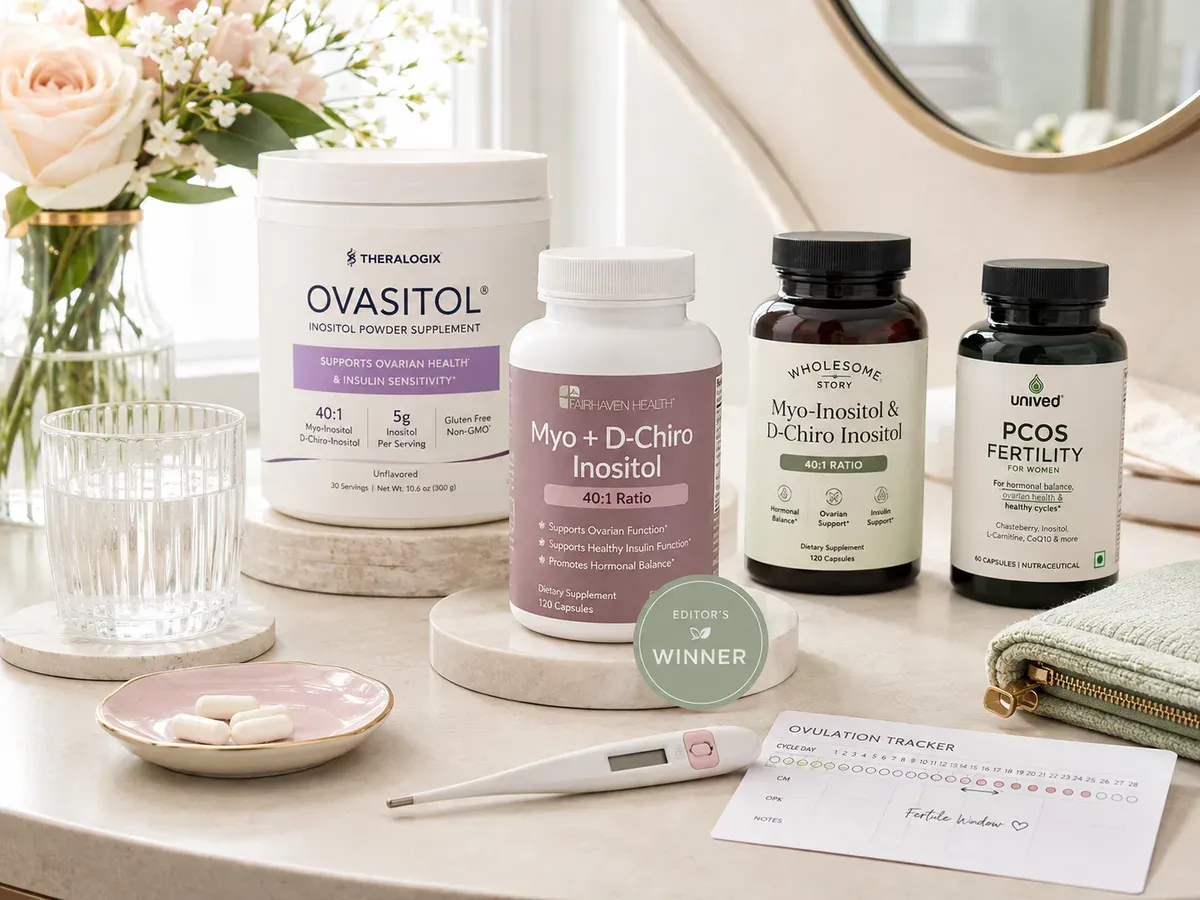
How we evaluate these products
This comparison is a desk-research review. We base it on product labels, manufacturer and retailer information, and peer-reviewed evidence (PubMed/PMC), assessed under a multidisciplinary editorial framework covering clinical, pharmacy, dietetics, and supplement-quality criteria.
- Formula and ratio against the studied evidence
- Daily dose and serving burden
- Third-party testing and certifications
- Price per day (with the check date shown)
- Availability in the US market
- Safety, interactions, and who should ask a clinician first
We have not independently lab-tested these products. Rankings reflect formula, evidence alignment, and practical criteria — never commission.
Product details and prices checked August 7, 2026 — prices vary by retailer and over time.
Ovulation-focused buyers often want the most fertility-specific answer available. That instinct is understandable, but it can push readers toward products that look more targeted than the evidence or category logic really justifies.
The safer move is to start with a product that still makes sense inside the broader inositol evidence and only then ask how much fertility-branding the buyer actually wants layered on top.
Quick answer
- Best fertility-leaning capsule answer: Fairhaven.
- Best clean benchmark option: Ovasitol.
- Best mainstream capsule default: Wholesome Story.
- Most explicitly fertility-branded alternative: Unived.
What the evidence says about inositol and ovulation
The evidence is real but specific. A meta-analysis of randomized trials found inositol improved ovulation rate (RR 2.3) and menstrual cycle frequency (RR 6.8) compared with placebo in women with PCOS. A Cochrane review of inositol in subfertile women with PCOS reached a more cautious conclusion, noting the underlying trials were low-quality.
Two honest limits matter here: most trials are short (3–6 months) and PCOS-specific, and no trial in the anovulation meta-analysis evaluated live birth or miscarriage. That is why the strongest recommendation is a product that fits the evidence — a clean 40:1 formula — rather than the most fertility-sounding label.
Best fertility-leaning capsule answer: Fairhaven
Fairhaven is the easiest ovulation-focused recommendation to defend because it keeps the main formula logic believable while also fitting naturally into a TTC-style buyer journey.
The 40:1 capsule logic keeps it inside the studied evidence, while the fertility-specialist brand angle matches the buyer's actual intent. It is the balance of those two jobs — believable formula plus TTC feel — that makes it the default ovulation pick.
Best clean benchmark option: Ovasitol
Ovasitol still matters because some buyers do not need a more fertility-branded bottle. They need the cleanest benchmark product and a routine they can actually follow.
The 40:1 ratio has direct ovulation evidence: in a randomized comparison of seven myo-to-d-chiro ratios, the 40:1 combination was the one that best restored ovulation in PCOS patients. For buyers who want the evidence story clean, that is the anchor.
Best mainstream capsule default: Wholesome Story
Wholesome Story is the mainstream capsule default when the buyer wants the same 40:1 logic without a fertility-branded bottle or a powder routine. The evidence angle is the same as the benchmark; what changes is format and price positioning.
Most explicitly fertility-branded alternative: Unived
Unived is more niche and more explicitly fertility-branded. That can be attractive to the right buyer, but it is not automatically the strongest first recommendation for everyone.
The formula is real but specialized: 1100 mg of myo-inositol plus 300 mg of d-chiro-inositol per serving — a ratio much heavier in d-chiro than the studied 40:1 default. Availability is also a practical issue, since the product is India-focused and has shown as sold out in its main listings.
Anovulation deserves a workup, not just a supplement
If your cycles are consistently irregular or anovulatory, get a proper evaluation (hormone panel, ultrasound) rather than relying on supplements alone. And if you are trying to conceive, the 12-month mark (or 6 if you are over 35) is the point where a reproductive endocrinologist should be part of the conversation. Inositol can support the picture, but it does not replace ovulation induction or fertility treatment.
Final verdict
The best inositol for ovulation with PCOS is usually the product that keeps the main category decision believable while fitting a fertility-focused routine. Fairhaven leads because it balances those two jobs well, while Ovasitol and Wholesome Story stay strong when format or brand style matter more.
What to read next
Finish your research with the guides that explain the formula, then compare the leading products before you commit.
References
- Inositol for subfertile women with polycystic ovary syndrome
- Inositol treatment of anovulation in women with polycystic ovary syndrome: a meta-analysis of randomised trials
- Inositol for Polycystic Ovary Syndrome: A Systematic Review and Meta-analysis to Inform the 2023 Update of the International Evidence-based PCOS Guidelines
- The 40:1 myo-inositol/D-chiro-inositol plasma ratio is able to restore ovulation in PCOS patients: comparison with other ratios
Frequently Asked Questions
For many buyers it is a fertility-leaning but still believable product like Fairhaven, with Ovasitol and Wholesome Story staying strong depending on format preference.
Not automatically. A cleaner product is often easier to defend and easier to keep taking consistently.
Not by itself. Powder versus capsules still comes down mostly to routine fit.
The evidence is mostly PCOS-specific. Most trials recruited women with PCOS, so outside PCOS the support is much thinner. If you do not have PCOS but cycles are irregular, that is even more reason to get a medical workup rather than assume a supplement is the missing piece.